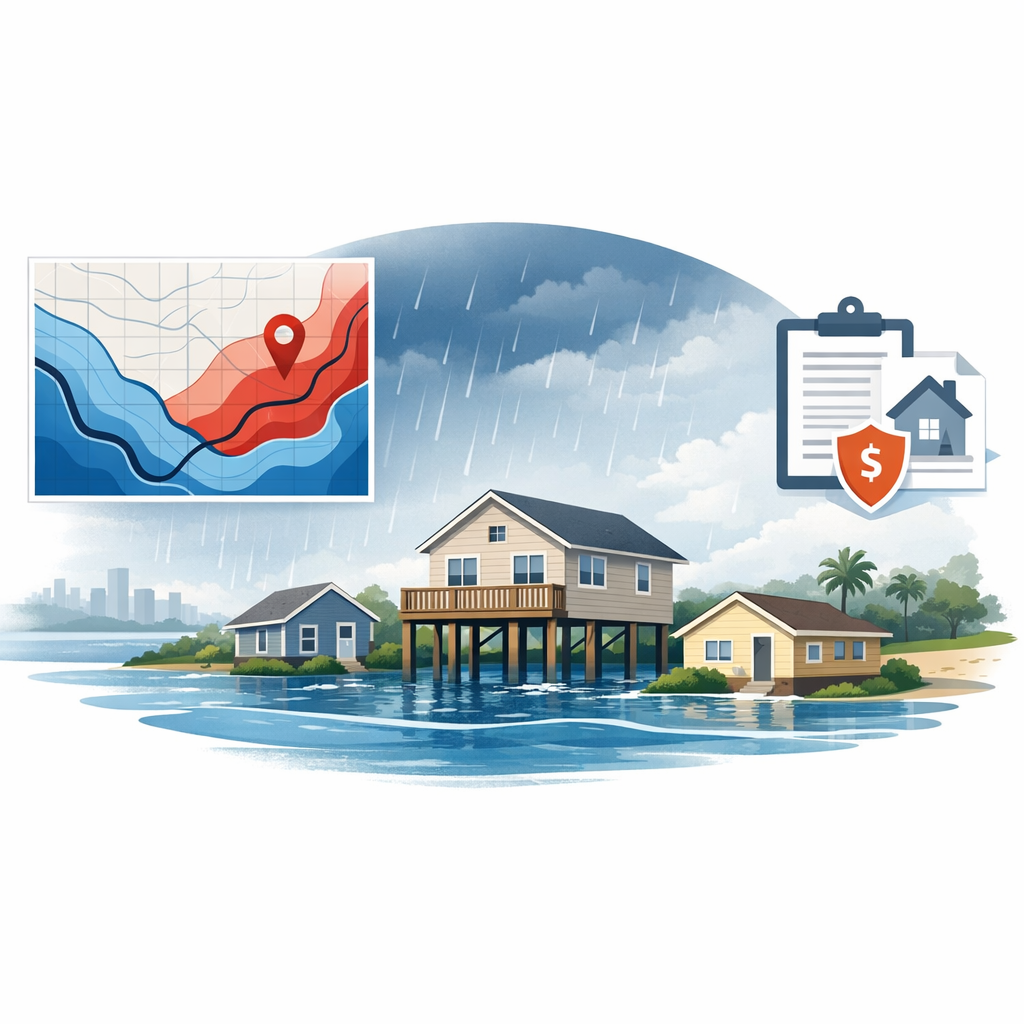
Flood Zone D: Undetermined Flood Risk Explained
Flood Zone D is FEMA's designation for areas where flood hazards are undetermined but possible. It's the "we don't know yet" zone — and that uncertainty creates unique challenges for property owners, lenders, and real estate professionals.
What Is Flood Zone D?

Zone D identifies areas where FEMA has not conducted a flood hazard analysis and no flood hazard data is available. The key distinction is that Zone D does not mean "no risk" — it means "unknown risk."
Key Characteristics
- Risk level: Undetermined (possible but unanalyzed)
- BFE established: No
- SFHA designation: No
- Insurance required: Not mandated by federal law, but lenders may require it
- Insurance available: Yes, through NFIP (if community participates) and private insurers
- FEMA study: None completed for this area
Where Zone D Exists
Zone D is typically found in:
- Remote or rural areas where FEMA hasn't prioritized mapping
- Areas with limited development that didn't justify the cost of a flood study
- Recently annexed areas that haven't been incorporated into the community's FIRM
- Areas where FEMA has insufficient data to make a determination
- Regions with complex topography or hydrology that hasn't been modeled
The Uncertainty Problem
Zone D creates a unique challenge because the absence of data is not the same as the absence of risk:
What We Don't Know
- Whether the area is subject to 1% annual chance flooding
- What the Base Flood Elevation might be
- Whether the area would qualify as an SFHA if studied
- What flood depths or velocities to expect during a storm event
- How upstream or downstream conditions affect flood risk
What We Do Know
- FEMA has identified the possibility of flood hazard
- The area hasn't been studied, not that it's been cleared
- Zone D areas can be reclassified to any other zone once studied — including high-risk SFHA designations
- Properties in Zone D absolutely can and do flood
Insurance in Zone D
Federal Requirement

Zone D is not an SFHA, so the federal mandatory purchase requirement does not technically apply. However, the situation is more nuanced than other non-SFHA zones.
Lender Discretion
Many lenders treat Zone D differently from Zone X because of the uncertainty:
- Some lenders require flood insurance for Zone D properties as a matter of internal policy
- Others follow the strict federal standard (no SFHA = no requirement)
- FHA, VA, and USDA may have their own policies regarding Zone D
- Secondary market investors (Fannie Mae, Freddie Mac) may have specific requirements
Bottom line: Check with your lender. Don't assume flood insurance won't be required for a Zone D property.
NFIP Availability
Flood insurance through the NFIP is available in Zone D if the community participates in the NFIP. If the community doesn't participate:
- NFIP insurance is not available
- Private flood insurance may be the only option
- The lender may not be able to make the loan if insurance can't be obtained
Pricing
Because Zone D has no established flood risk data, insurance pricing is somewhat arbitrary:
- NFIP: Rates are typically moderate — not as low as Zone X but not as high as SFHA zones
- Private insurers: May use their own risk models to price Zone D properties
- Approximate range: $400-1,200/year for typical residential properties (varies widely)
Construction in Zone D
FEMA Requirements
FEMA does not impose specific construction standards for Zone D because no flood data exists to base standards on.
Local Requirements
Communities may establish their own building requirements for Zone D areas, including:
- Minimum elevation standards
- Drainage requirements
- Setbacks from water bodies
- Foundation requirements
Best Practice
Even without regulatory requirements, building in Zone D should consider flood risk:
- Elevate the structure above surrounding grade
- Grade the site to direct water away from the building
- Use flood-resistant materials where practical
- Elevate utilities above potential flood levels
- Maintain clear drainage around the structure
What Happens When FEMA Studies a Zone D Area
When FEMA conducts a Flood Insurance Study for a Zone D area, the area will be reclassified. Possible outcomes include:
Reclassified as SFHA (Zone A or AE)
If the study shows a 1% or greater annual chance of flooding:
- The area becomes a Special Flood Hazard Area
- Mandatory flood insurance requirements apply to federally backed mortgages
- New construction standards take effect
- Property owners with existing mortgages are notified and must obtain insurance
Reclassified as Zone X (Shaded or Unshaded)
If the study shows the flood risk is moderate or low:
- The area is mapped as Zone X
- No mandatory insurance requirement
- Property owners get more clarity about their actual risk level
Timeline for Reclassification
There's no guaranteed timeline for when FEMA will study Zone D areas. It depends on:
- Congressional funding for FEMA mapping programs
- Community priorities and participation
- Development pressure in the area
- Disaster events that highlight mapping gaps
- State and local advocacy for updated maps
Some Zone D areas have remained unstudied for decades.
Strategies for Zone D Property Owners
1. Purchase Flood Insurance
Don't wait for FEMA to study your area. The risk exists whether it's quantified or not. Flood insurance in Zone D is typically affordable and provides essential protection against an unknown risk.
2. Research Available Data
Even though FEMA hasn't completed a formal study, other data sources may provide flood risk information:
- USGS stream gauge data for nearby waterways
- Local government flood studies or stormwater management plans
- Historical flood records from the community or state
- Topographic analysis using elevation data (LiDAR)
- Soil maps that indicate flood-prone soil types (alluvial, hydric)
3. Consult Local Officials
The local floodplain administrator or building department may have knowledge about flood risks in Zone D areas that isn't reflected on FEMA maps. They may also know about planned FEMA studies.
4. Prepare for Reclassification
If you're buying or building in Zone D, consider the possibility that the area may be reclassified as an SFHA in the future:
- Build to flood-resistant standards even if not required
- Elevate the structure above surrounding grade
- Plan for the potential cost of mandatory flood insurance
- Factor future insurance costs into your investment analysis
5. Get an Elevation Certificate
An EC documents your property's elevation, which can be valuable if:
- The area is later studied and reclassified
- You need to demonstrate your risk level to a lender or insurer
- You want to pursue a LOMA if the property is ultimately mapped into an SFHA
For Professionals
Lenders
Zone D requires careful handling:
- Check your institution's specific policy on Zone D flood insurance requirements
- Verify community NFIP participation — if the community doesn't participate, federal flood insurance is unavailable
- Consider requiring flood insurance even if not technically mandated
- Monitor for FEMA map updates that could reclassify the area
Title Companies
Flag Zone D determinations for additional review. The lender may need to make a case-by-case decision about flood insurance requirements.
Real Estate Agents
Be transparent with clients: "Zone D means FEMA hasn't studied this area for flood risk. That's different from saying there's no risk. I recommend flood insurance as a precaution."
Get Your Zone D Determination Instantly
Zone D properties need certified flood determinations just like any other zone. FloodCert.org identifies Zone D designations instantly and provides the data lenders need for compliance decisions.