Flood Zone AO: Sheet Flow Shallow Flooding Explained
Flood Zone AO is a Special Flood Hazard Area (SFHA) designation for areas subject to shallow flooding in the form of sheet flow on sloping terrain. Flood depths in Zone AO are typically 1 to 3 feet, and unlike Zone AE or AH, Zone AO uses flood depth numbers rather than Base Flood Elevations.
What Is Flood Zone AO?

Zone AO identifies areas where floodwater moves as a shallow sheet across the ground surface, typically on gentle to moderate slopes. Rather than collecting in a defined channel (like riverine flooding) or ponding in low spots (like Zone AH), sheet flow spreads broadly across the landscape.
Key Characteristics
- Flood type: Sheet flow (broad, shallow overland flow)
- Typical depth: 1 to 3 feet
- BFE established: No — flood depths are specified instead
- Risk level: High (1% annual chance)
- Insurance required: Yes, for federally backed mortgages
- SFHA designation: Yes
How Sheet Flow Works
Sheet flow occurs when rainfall exceeds the ground's ability to absorb it and water flows overland as a broad, shallow sheet rather than concentrating in a channel. This commonly happens:
- On alluvial fans (fan-shaped deposits at the base of mountains)
- Along the base of hillsides and bluffs
- In areas with impervious surfaces that prevent infiltration
- During intense rainfall events that overwhelm natural drainage
- In desert and semi-arid environments where dry soil can't absorb sudden downpours
Zone AO vs. Zone AH: Understanding the Difference
Both Zone AO and AH deal with shallow flooding, but the mechanism is different:

| Feature | Zone AO (Sheet Flow) | Zone AH (Ponding) |
|---|---|---|
| Water behavior | Flows across surface | Collects in low spots |
| Terrain | Sloping | Flat |
| Velocity | Moderate (moving water) | Very low (standing water) |
| Duration | Shorter (water flows through) | Longer (water sits) |
| Elevation reference | Flood depths (1, 2, or 3 ft) | Base Flood Elevation |
| Primary hazard | Moving water + debris | Prolonged standing water |
The distinction matters because moving water is generally more dangerous than standing water, even at the same depth. Sheet flow can carry debris, erode soil, and exert force on structures.
Understanding Flood Depth Designations
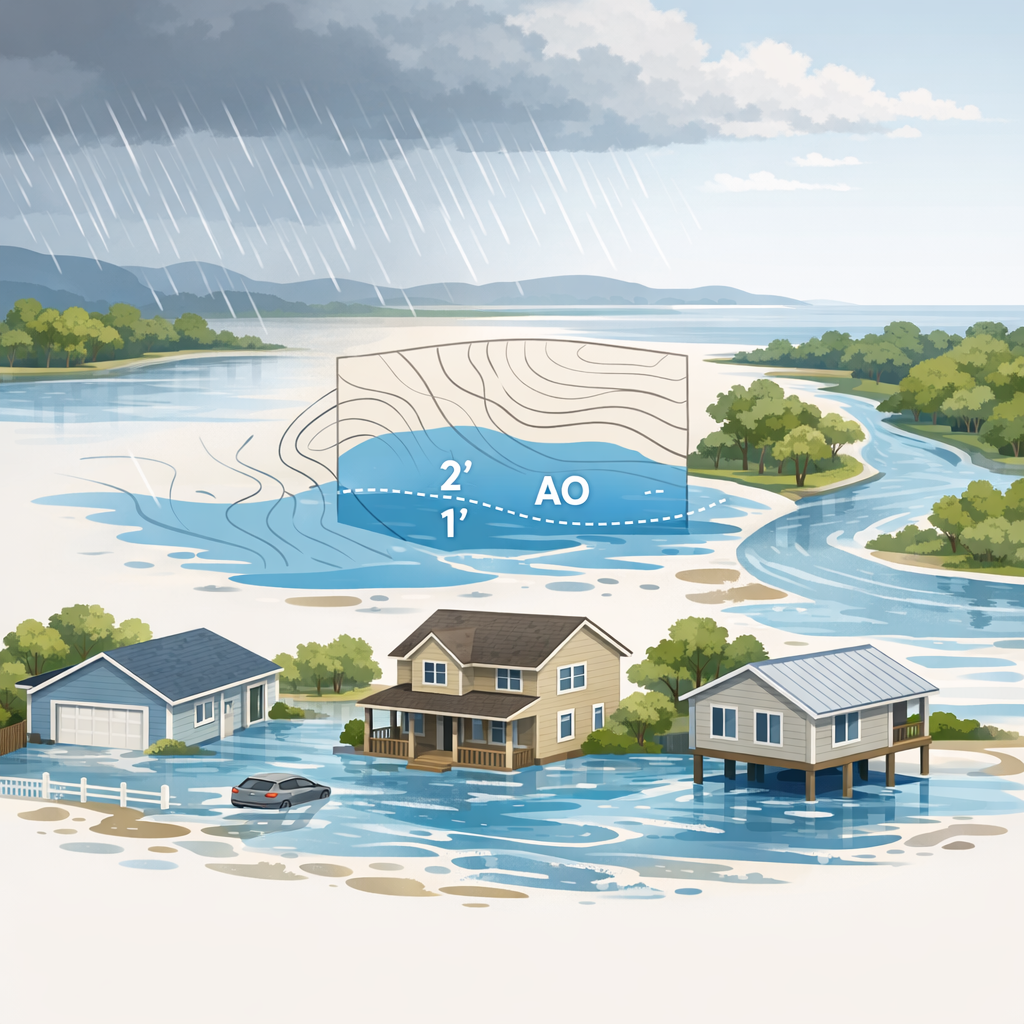
Unlike Zone AE where a specific BFE is given (e.g., "BFE = 342 feet NAVD88"), Zone AO specifies flood depths — the expected depth of water above ground level during the 1% annual chance flood:

- Depth 1: 1 foot of flooding above ground
- Depth 2: 2 feet of flooding above ground
- Depth 3: 3 feet of flooding above ground
On FEMA maps, you'll see the depth number printed within the Zone AO area. If no depth is specified, a depth of 2 feet is assumed for insurance rating and construction purposes.
Construction Standards in Zone AO
Building in Zone AO requires compliance with specific standards that account for sheet flow:
Elevation Requirements
The lowest floor of a new structure (including basement) must be elevated above the highest adjacent grade by at least the depth number specified on the FIRM:
- Depth 1 → Elevate at least 1 foot above highest adjacent grade
- Depth 2 → Elevate at least 2 feet above highest adjacent grade
- Depth 3 → Elevate at least 3 feet above highest adjacent grade
If no depth is specified, elevate at least 2 feet above the highest adjacent grade.
Drainage Path Requirement
This is unique to Zone AO: communities must require that adequate drainage paths are provided around structures to guide floodwaters around and away from proposed construction. This means:
- Grading must direct water flow away from the building
- Drainage swales or channels may be required
- The flow path cannot be obstructed by the building or site improvements
- Certification by a licensed engineer may be required
Additional Standards
- Flood-resistant materials below the flood level
- Proper anchoring against hydrostatic and hydrodynamic forces
- Flood openings in enclosed areas below the flood level
- Utilities elevated above the flood depth
Insurance in Zone AO
Mandatory Purchase
As an SFHA, Zone AO requires flood insurance for all federally backed mortgages — no exceptions.
Rating in Zone AO
Under Risk Rating 2.0, Zone AO properties are rated using the same comprehensive methodology as other zones. However, the flood depth designation plays a role similar to BFE in determining premiums.
Properties that have been properly elevated above the specified flood depth generally see lower premiums than those at or below grade.
Approximate Premium Ranges
- Properly elevated: $500 – $1,500/year
- At grade: $1,000 – $3,000/year
- Below standard: $2,000 – $5,000+/year
Risks Specific to Zone AO
Sheet flow presents some unique hazards:
Debris Transport
Moving water carries debris — rocks, vegetation, soil, and man-made materials. Even 1-2 feet of moving water can transport debris that damages structures and vehicles.
Erosion
Sheet flow can erode soil around foundations, potentially undermining structural support. Properties on slopes are particularly vulnerable.
Rapid Onset
In arid environments, sheet flow can develop very quickly during intense rainstorms. Flash floods on alluvial fans are especially dangerous because they combine sheet flow with debris flow.
Unpredictable Flow Paths
Unlike riverine flooding, which follows established channels, sheet flow can shift paths based on terrain changes, debris accumulation, or development. A property that hasn't flooded historically may flood after upstream development changes drainage patterns.
Mitigation Strategies for Zone AO
Site Design
- Grade the site to direct sheet flow around the structure
- Install drainage channels or swales to manage flow paths
- Avoid obstructing natural flow paths with landscaping or structures
- Use permeable surfaces where possible to reduce runoff
Structural Protection
- Elevate the building above the specified flood depth
- Reinforce foundations against erosion and undermining
- Install debris deflectors on the upstream side of the structure
- Use flood-resistant materials for any surfaces below the flood depth
Property Protection
- Elevate utilities above the expected flood depth
- Install backflow prevention on sewer connections
- Maintain clear drainage paths — keep channels and swales free of debris
- Landscape for flood management — use native plants and gravel instead of solid barriers
For Real Estate Professionals
Explaining Zone AO to Buyers
Zone AO can be confusing because it uses flood depths rather than BFEs. When explaining it to buyers:
- "This area can experience 1-3 feet of moving water flowing across the surface during a major storm"
- "The good news is that this is shallow flooding, and proper elevation and drainage can effectively mitigate the risk"
- "Flood insurance is required and typically costs $X-Y per year for a property like this"
Transaction Considerations
- Flood determination is required (same as any SFHA)
- Insurance must be in place before closing
- The specified flood depth should be noted and communicated to all parties
- Construction and renovation plans must account for Zone AO standards
Know Your Zone Before You Transact
Zone AO properties need the same certified flood determination as any other SFHA. FloodCert.org delivers instant, accurate flood certifications — so you know exactly what you're dealing with.