Flood Zone A: What It Means, Insurance Requirements, and What You Need to Know
Flood Zone A is one of FEMA's high-risk flood zone designations, classifying an area as a Special Flood Hazard Area (SFHA) with a 1% or greater annual chance of flooding. What distinguishes Zone A from its more detailed counterpart, Zone AE, is that Base Flood Elevations (BFEs) have not been determined through detailed engineering studies.
What Defines Flood Zone A?
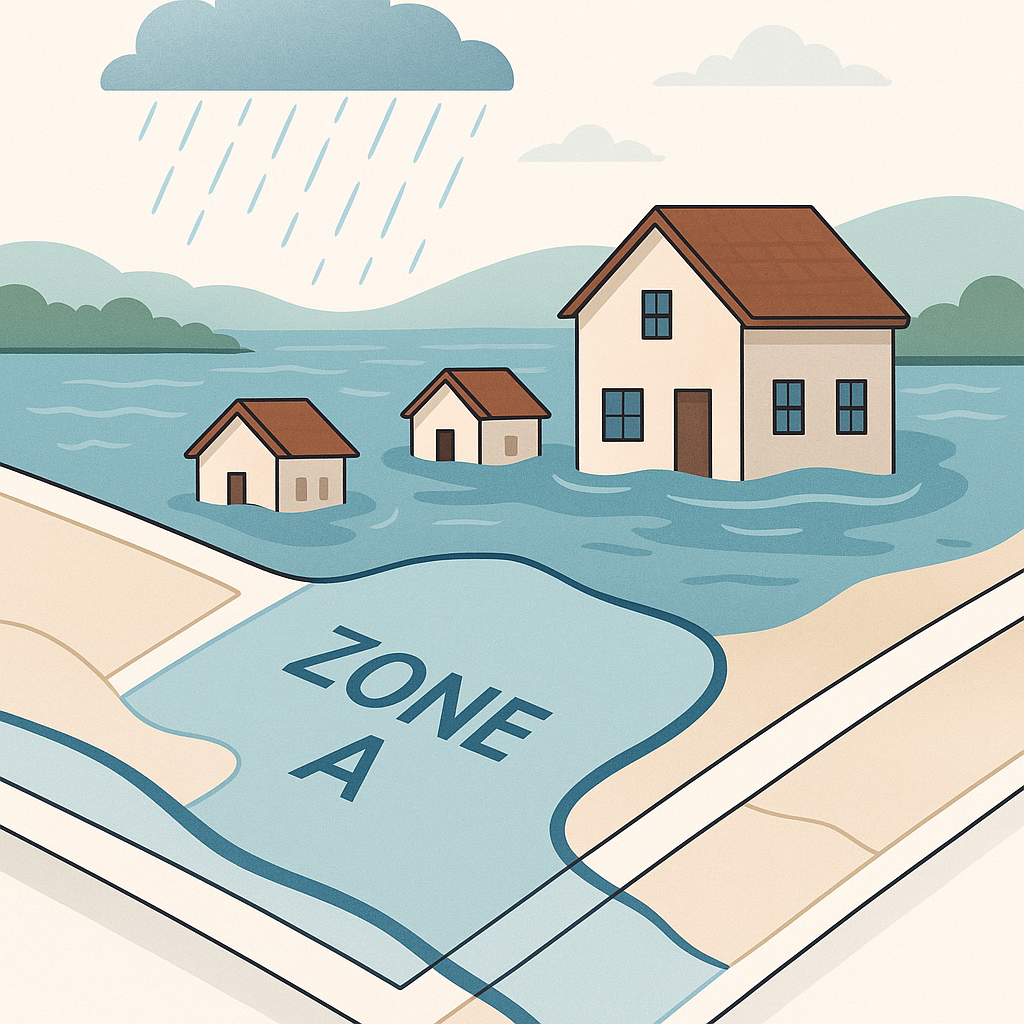
Zone A areas are identified through FEMA's Flood Insurance Studies, but unlike Zone AE, they haven't undergone the detailed hydraulic analysis needed to establish precise Base Flood Elevations. This typically means:
- FEMA has identified the area as flood-prone based on approximate methods
- The boundary of the flood zone is known, but the exact expected flood depths are not
- The community may be mapped under FEMA's approximate study methodology rather than a detailed study
Zone A is often found in:
- Rural and semi-rural areas where FEMA hasn't invested in detailed studies
- Newly identified flood areas awaiting more thorough analysis
- Smaller watersheds where the cost of detailed studies hasn't been justified
- Communities participating in the NFIP's Emergency Program (initial mapping phase)
Zone A vs. Zone AE: What's the Difference?
| Feature | Zone A | Zone AE |
|---|---|---|
| Flood risk level | High (1% annual chance) | High (1% annual chance) |
| Base Flood Elevation | Not determined | Determined |
| Study type | Approximate | Detailed |
| Insurance required? | Yes (with federal mortgage) | Yes (with federal mortgage) |
| Insurance pricing precision | Less precise | More precise |
| Building requirements | Varies by community | Specific BFE-based standards |

The practical impact of this difference is significant:
- Insurance pricing: Without a BFE, NFIP rating in Zone A can be less favorable. Under Risk Rating 2.0, FEMA now uses additional data sources to assess risk, which has somewhat reduced this disparity.
- Construction standards: Communities may establish their own BFE requirements for Zone A, or they may require developers to determine BFE on a project-by-project basis.
- LOMA eligibility: Challenging a Zone A designation can be more difficult without a clearly established BFE to compare against.
Insurance Requirements
Mandatory Purchase

Like all SFHA designations, Zone A triggers the mandatory flood insurance purchase requirement for federally backed mortgages. Borrowers must:
- Obtain a flood insurance policy before closing
- Maintain coverage for the life of the loan
- Meet minimum coverage requirements
Insurance Costs
Flood insurance in Zone A can vary widely:
- Pre-FIRM buildings (built before the community's initial FIRM): Often eligible for subsidized rates, though these are being phased out under Risk Rating 2.0
- Post-FIRM buildings: Rated based on available data; without BFE, the rating may use estimated flood depths
- Typical range: $800 – $4,000+ per year for residential properties, though this varies significantly by property
Getting Better Rates
If you're in Zone A, consider these options:
- Request a BFE determination: Hire a licensed engineer to determine the BFE for your specific area. This can provide more accurate insurance rating.
- Get an Elevation Certificate: Even without a published BFE, an EC documents your property's elevation for insurance rating purposes.
- Compare private insurance: Private flood insurers may use their own risk models and could offer competitive rates.
- Pursue a LOMA: If your property is naturally above the flood level, a LOMA can remove the mandatory insurance requirement.
Building in Zone A
Construction in Zone A must comply with both FEMA's minimum standards and local floodplain management ordinances. Because there's no established BFE, communities handle this in different ways:
Option 1: Community-Established BFE
Some communities have established their own BFEs for Zone A areas based on available data. Construction must meet or exceed these elevations.
Option 2: Developer-Determined BFE
The community may require the developer or builder to conduct their own engineering study to determine the BFE for the specific project site. This adds cost and time but provides accurate elevation standards.
Option 3: Minimum Standards
At minimum, FEMA requires that new construction in Zone A be:
- Elevated to or above the BFE (when available) or to the community's regulatory standard
- Anchored to prevent flotation, collapse, or lateral movement
- Built with flood-resistant materials below the flood level
- Designed with adequate drainage paths to guide floodwaters around and away from structures
Substantial Improvement Rule
If you're renovating or repairing an existing structure in Zone A and the cost exceeds 50% of the building's market value, the entire structure must be brought into compliance with current floodplain management standards. This applies to both improvements and damage repairs.
Impact on Property Transactions
For Buyers
- Budget for flood insurance as an ongoing cost of ownership
- Factor the zone designation into your purchase price negotiation
- Understand that without a BFE, construction standards and insurance costs may be less predictable
- Consider hiring an engineer to determine the actual flood risk more precisely
For Sellers
- Disclose the Zone A designation as required by your state
- Having an Elevation Certificate on hand can help demonstrate the property's actual flood risk
- A LOMA (if the property qualifies) can remove the SFHA designation and make the property more attractive to buyers
For Lenders
- Zone A triggers the same compliance requirements as Zone AE — mandatory insurance, borrower notification, and ongoing monitoring
- Ensure your flood determination provider correctly identifies Zone A (vs. AE or other zones)
- Track FEMA map updates — Zone A areas are often candidates for future detailed studies that may reclassify them as AE
Can Zone A Change?
Yes. FEMA regularly updates its Flood Insurance Rate Maps, and Zone A areas can change in several ways:
- Upgraded to Zone AE: When FEMA completes a detailed study, Zone A areas are typically reclassified as Zone AE with established BFEs
- Removed from SFHA: If new data shows the area doesn't meet the 1% annual chance threshold, it may be reclassified as Zone X
- Individual property changes: Through the LOMA or LOMR process, individual properties can be removed from Zone A
Key Takeaways
- Zone A is high-risk — it carries the same flood insurance mandate as Zone AE
- No BFE doesn't mean no risk — it means the risk hasn't been precisely quantified
- Insurance is required for federally backed mortgages
- Options exist for reducing costs — Elevation Certificates, LOMAs, and private insurance can all help
- Zone A may eventually become Zone AE as FEMA updates its studies
Get Your Flood Zone Determination Instantly
Whether a property is in Zone A, AE, or X, FloodCert.org delivers certified flood determinations in seconds. Don't let uncertainty slow your transaction — know the flood zone before you commit.